A few weeks ago, I presented Ume, Mate, and Shin. So, what if we combine them and look for potential bugs in Pharo?
This idea led to PerfUMate.
PerfUMate
Each tool does one thing well:
- Ume is the fuzzer engine. It keeps mutating inputs and keeps the ones that look promising:
- Coverage
- Execution time
- Method calls
- Mate generates object instances built from a grammar.
- Shin shrinks the potential bugs found until only the part that matters is left.
Wiring the three together in PerfUMate hides all of that behind some simpler abstractions.
So, given a few object inputs, the code to run, and what you’re looking for:
report := PerfUMate new examples: { order1. order2. order3 }; benchmark: [ :order | Checkout new process: order ]; lookFor: #slowInputs; budget: 5 minutes; run.report open.
The pipeline
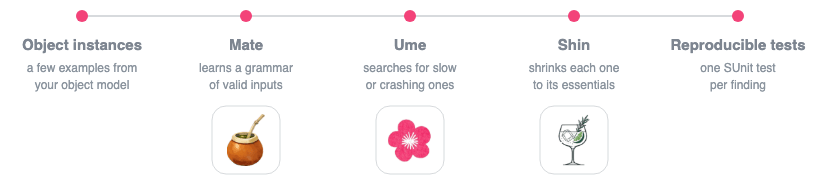
PerfUMate goes through five steps.
1. Infer what an input looks like (Mate). Mate infers a grammar from your examples: which classes appear, what goes in each instance variable, how big the collections get, which ranges the numbers live in.
2. Measure what “normal” is. It runs your examples and a few freshly generated inputs, and keeps the median time. That’s the yardstick: when looking for slow inputs, “slow” means five times slower than this median.
3. Fuzzing (Ume). Ume starts from your examples and keeps mutating them. There are six mutators. Which mutator to use next isn’t random: MOpt scheduler learns which
mutators pay off for this code and picks them more often. And each run is scored by what you asked for: execution time (or method calls) for #slowInputs; new coverage and new errors for #errors.
The inputs with the best scores go back into the pool to be mutated again.
4. Check. Every candidate is run again on its own. A slow input is re-timed several times and has to stay above the limit; an error has to happen again, with the
same error class at the same place. Two inputs that fail the same way are one finding, not two.
5. Shrink (Shin). Each confirmed finding is minimized while it keeps failing the same way: Shin’s delta debugging over every collection and every string, numbers pushed towards 0, 1, or -1. If the original input respected the grammar, the small one does too, so you don’t end up with a “bug” that only exists in an impossible object. And if a shrunk slow input stops being slow when measured again, you get the original instead.
The report provides the minimized found inputs, a few charts of the search, and Unit tests you can paste into your project so the bug never comes back.
Pharo Hunting
The idea for PerfUMate came from hunting bugs ( performance bottlenecks, unexpected behavior, or crashes ). In the article, we perform a first hunt, exploring the compiler, Pharo collections, STON, Zinc, and the JIT. The result? 31 potential bugs.
Where do we start?
Before anything, we have to answer one question per library: what should always be true/expected? A fuzzer is great at finding inputs, but it only knows something is wrong if you tell it what “right” means.
Let’s start with a little example on NeoJSON:
PerfUMate new examples: ( '{"a":[1,2.5e10,-3,{"b":null,"c":true}]}' '[]' '"\u0000\t"' ); benchmark: [ :json | MyHuntCampaigns checkNeoJSON: json ]; lookFor: #errors; budget: 5 minutes; instrument: { 'Neo-JSON-Core' }MyHuntCampaigns class >> checkNeoJSON: aString [ | value | value := [ NeoJSONReader fromString: aString ] on: NeoJSONParseError do: [ :error | ^ self ]. (NeoJSONReader fromString: (NeoJSONWriter toString: value)) = value ifFalse: [ PerfUMateBrokenInvariant signal: 'inconsistent parsing' ]]
examples:are where the search starts. Mate learns from them what a “normal” input looks like.benchmark:runs one input and checks the property.lookFor: #errorstells Ume what’s interesting: new coverage and new errors. For performance bugs, it would be#slowInputs.instrument:is the Pharo package or methods that Ume will instrument to gather feedback.
In PerfUMate terms, the benchmark is a block that does those runs and
signals PerfUMateBrokenInvariant when the answers differ.
So, let’s hunt!
| Campaigns | Input type | Benchmark |
|---|---|---|
| NeoJSON, NeoCSV, STON, Fuel | text | what you write, you read back equal |
| Compiler, number parsing, regex, Microdown | text | anything goes in, nothing but a syntax error comes out |
| Zinc: URLs, MIME types, encoders | text, bytes | parse, print, parse again: same thing |
| Fuel, STON | object graphs | a graph comes back with the same meaning, and its Sets still find their elements |
| Copying | object graphs | deepCopy and veryDeepCopy keep the meaning |
| Equality | object graphs | = is symmetric, and equal objects have equal hashes |
| Printing | object graphs | everything prints, and its storeString compiles back to an equal object |
What did we find?
Here are some of the 31 potential bugs:
Microdown
Ume found a 244-character Markdown document that broke Microdown. Shin shrank it:
Microdown parse: '|'."SubscriptOutOfBounds: 1 in an OrderedCollection()"
A line with just a pipe opens a table, and closing a table starts with rows first. No rows, no first. Its sibling came from a 372-character document:
Microdown parse: (String cr join: ( '- i' '- e' ))."PrimitiveFailed: primitive #basicNew: in ByteString class failed"
Regex
'::' asRegex. "SubscriptOutOfBounds: an empty :selector: predicate"'a{x}' asRegex. "MessageNotUnderstood: receiver of #- is nil, the bound is not a number"'[[:]]' asRegex. "MessageNotUnderstood: receiver of #asInteger is nil, reads past the end"
Zinc
ZnMimeType fromString: 'text'."PrimitiveFailed: primitive #basicNew: in ByteString class failed"
ZnBase64Encoder new decode: '=='. "PrimitiveFailed"
NeoJSON
NeoJSONReader fromString: '1e-2'. "(1/100), a Fraction"NeoJSONReader fromString: '1.0e-2'. "0.01"
NeoJSONWriter toString: Float nan. "'Float nan'"
STON
STON fromString: (STON toString: (Bag with: 1 -> 2))."MessageNotUnderstood: Association >> #adaptToNumber:andSend:"
STON fromString: '1/0'. "ZeroDivide"STON fromString: 'Time[12]'. "MessageNotUnderstood: SmallInteger >> #readStream"STON fromString: '[[1],@21]'. "KeyNotFound: key 21"
Fuel
| copy |copy := FLMaterializer materializeFromByteArray: (FLSerializer serializeToByteArray: (Set with: (Set withAll: (1 2 3)))).copy includes: copy anyOne. "false"
deepCopy
| set copy |set := IdentitySet with: 'k' copy.copy := set deepCopy.copy includes: copy anyOne. "false"
Equality
[97] = 'a'. "true"'a' = [97]. "false"(1 to: 3) = (1 2 3). "true"(1 to: 3) hash = (1 2 3) hash. "false"(Set withAll: (1 2)) = (IdentitySet withAll: (1 2)). "true, with different hashes"
storeString
(#+ -> 4) storeString. "'(#+->4)': #+-> is read as one symbol"(1 @ -0.0) storeString. "'((1@-0.0))': read as the binary selector #@-"
The 31 findings
| # | Where | What | Kind |
|---|---|---|---|
| 1 | Kernel | LargeNegativeInteger>>asFloat rounds the wrong way | wrong |
| 2 | Compiler | malformed radix literals (16rs) | crash |
| 3 | Compiler | <primitive: := | crash |
| 4 | Regex | '::' asRegex | crash |
| 5 | Regex | 'a{x}' asRegex | crash |
| 6 | Regex | '[[:]]' asRegex | crash |
| 7 | Zinc | Content-Type without a slash, also from ZnRequest readFrom: | crash |
| 8 | Zinc | Base64 with more padding than data | crash |
| 9 | Zinc | UTF-16: byte order mark honoured anywhere | wrong |
| 10 | Zinc | UTF-16: lead surrogate swallows the next character | wrong |
| 11 | Zinc | UTF-16: lone trail surrogates accepted | wrong |
| 12 | NeoJSON | 1e-2 read as a Fraction | wrong |
| 13 | NeoJSON | infinity and NaN written as Smalltalk code | wrong |
| 14 | STON | out-of-range reference | crash |
| 15 | STON | zero denominator | crash |
| 16 | STON | Time[12] and friends | crash |
| 17 | STON | 16 characters make the reader loop forever | hang |
| 18 | STON | a Bag holding an Association can’t be read back | crash |
| 19 | Microdown | a line that is just ` | ` |
| 20 | Microdown | list item indented by four spaces | crash |
| 21 | Fuel | a Set holding a collection loses it | wrong |
| 22 | Collections | deepCopy of IdentitySet and IdentityDictionary | wrong |
| 23 | Collections | Interval = Array, different hashes | wrong |
| 24 | Collections | Set = IdentitySet, different hashes | wrong |
| 25 | Collections | ByteArray = String, but not the other way | wrong |
| 26 | Collections | NaN key breaks Dictionary printing | crash |
| 27 | Kernel | storeString of 1 @ -0.0 | wrong |
| 28 | Kernel | storeString of #+ -> 4 | wrong |
| 29 | Kernel | storeString of symbols like #¥ | wrong |
| 30 | VM | JIT comparison of large integers with floats | wrong |
| 31 | VM | 0 bitShift: 64 | wrong |
What now?
Every bug has a draft issue with the cause and the exact campaign that found it. The complete report was sent to the community to consider whether they deserve treatment or not.
For now, that’s episode 1. If you know a corner of Pharo that deserves a hunt, let me know; maybe we can find something there!.
Thanks for reading! 🙂

